Gestamp formalizes its commitment to fight against the climate change
Despite the COVID-19, even though it was a storm that shook the world, and in spite of the humanitarian nightmare, climate change is considered the major challenge of the planet. And time, according to experts, is pressing.
Social, economic and business activity must persist, but the clock is ticking. Industrial development, decarbonisation and firm steps towards a more sustainable world are the key to compliance with the Paris Agreement, to limit the increase in global temperature to below 2°C, compared to pre-industrialization levels. They are, after all, the key to everyone's future.
In Gestamp we are not oblivious to this reality. In fact, it is in our DNA to work towards sustainable mobility; to help produce a lighter car so that it emits less emissions during its use; in other words, better for the environment.
Now, we have taken a crucial step forward. We have formalised our commitment to fight climate change by setting emission reduction targets for 2030, according to scientific criteria, which have been approved by the Science Based Targets Initiative (SBTI). At Gestamp, we have thus become one of the few TIER1 companies in the world, and the first company in the automotive sector in Spain, with established and approved greenhouse gas (GHG) emission reduction targets.
As context, it should be noted that Science Based Targets Initiative (SBTI) is an international initiative, which evaluates and validates the greenhouse gas emission reduction targets of companies, based on the Paris Agreement of 2015, in which the 195 countries committed themselves to limit global warming to below 2 degrees.
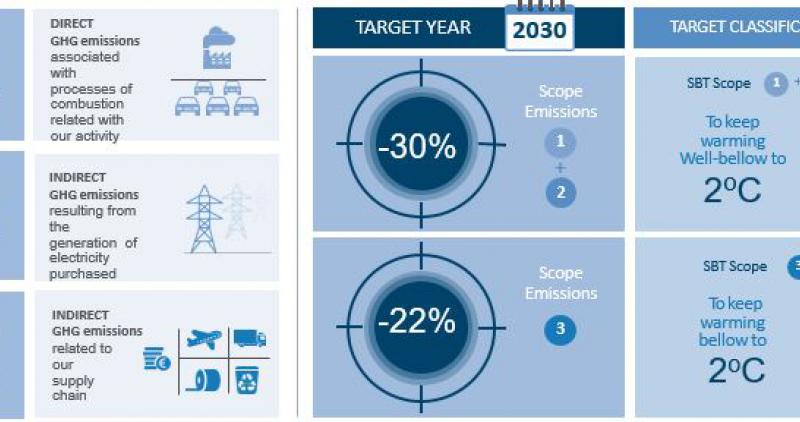
Based on 2018, at Gestamp, we are committed to reducing by 30% our direct emissions, associated with processes of combustion related with our activity, and those emissions resulting from the generation of the electricity consumed at our centers - activities included in what are called Scope 1 and Scope 2 of our Carbon Footprint respectively. In addition, we have also set ourselves the goal of reducing indirect emissions from our supply chain by 22% by 2030, as part of Scope 3 of our Carbon Footprint.